

How To Clean Clutch On A John Deere Gator That Squeals
A squealing ATV belt signifies that something is not quite right with either the clutch assembly or the belt itself. It's an abrasive event that may or may non exist difficult to fix at dwelling.
To brand the troubleshooting a flake easier, we have structured the mail according to the various symptoms your ATV may be having. Under each symptom, nosotros address the different bug that may be causing the behavior you are experiencing.
Caution! Never turn on the key, commencement the engine, or run a four-wheeler with the clutch cover off. It is potentially very dangerous and may mess upwardly components such equally the KEBC actuator memory (Kawasaki ATVs).
Symptom: The belt squeals at idle, merely the noise goes abroad when applying throttle
This is the most typical beliefs when struggling with ATV chugalug squeal. This symptom has a range of possible causes.
With the bike in gear and at idle, the principal clutch should normally be spinning freely without the clutch sheaves touching the belt. Every bit you employ throttle, the gap betwixt the clutch sheaves gradually tightens so that it grabs and starts spinning the belt.
When the clutch sheaves, for some reason, is grabbing the chugalug slightly when it should not, you become a chugalug bleat. It's the friction between rubber and metal is that is causing the characteristic squealing audio.
Along with the squealing audio at idle, the bike may be having the following symptoms:
The ATV is difficult to shift in and out of gear
When the clutch sheaves are non spinning freely at idle, information technology causes tension on the gears inside the transmission. The tension between the gears may require that you use excessive force to operate the gear shifter. In some cases, you won't be able to shift gears at all.
The squealing sound stops when shifting to neutral
When in neutral, the primary clutch should non be spinning and cannot afflict any force to the belt.
The squealing sound typically begins when the wheel shifts into gear and the main clutch activates.
Possible cause 1: The chugalug is too broad
Belt size tolerances on a CVT transmission are small. A belt that is but a fraction too wide may cause unwanted rubbing issues.
How to fix information technology:
- Employ an OEM belt
Aftermarket belts can offer better value, meliorate functioning, or both. Only they may also exist the cause of your belt squeal issues.
The reason can be small variations in manufacturing tolerances.
Most of the time, an aftermarket chugalug will work only fine. Simply when faced with a mysterious belt squealing issue, where no cause is to be found, your best bet is to install an OEM chugalug to see if this helps.
On the numerous ATV forums, yous will find the same story over and over. After several failed attempts, the noise disappeared entirely subsequently installing an original belt.
As most instances of belt squeal are belt-related in some way or form, nosotros recommend that y'all ever attempt with an OEM chugalug before spending time and money on the clutches themselves.
- Allow the belt to break in properly
A new belt will demand a few miles of running time to break-in. Let the specified break-in period to terminate, every bit this may be all that it takes to remove the chugalug noise.
Possible cause 2: Improper belt-to-sheave clearance on the primary clutch
When the chugalug wears, some people remove one or more clutch shims. This will decrease the width between the sheaves slightly, compensating for belt article of clothing. Perhaps information technology was yourself who did this some fourth dimension ago, or a previous possessor may take washed it.
When installing a new belt, it is going to be slightly wider than the old worn ane. Even with but 1 shim brusk from stock, y'all may get rubbing, causing chugalug bleat at idle.
How to prepare it
You can adjust the distance between the sheaves of the idle's primary clutch by calculation or removing shims. This allows for fine adjustment according to chugalug width.
The job tin exist washed at home if you lot take the tools required to split the clutch. If you don't, your best selection is removing the complete clutch associates and taking it to a dealer to practise the shimming for you.
This video demonstrates shimming a snowmobile primary clutch. The same basic principles apply to an ATV clutch.
Possible crusade 3: The belt is installed in the wrong direction
The proper way of installing a CVT chugalug is so that you can read the part number when continuing side by side to the ATV.
If it reads up-side-down, the belt is mounted the wrong way. This can, in some cases, cause belt bleat.
How to ready it:
Remove the belt, turn it around and install it again.
Possible cause iv: Stuck or worn out primary clutch heart sleeve/bearing
At idle, the belt should not be touching the sheaves of the primary clutch but resting against a bearing outside the clutch shaft.
If this bearing starts to wear or jams up completely, information technology won't spin as information technology should. Instead, it will start rubbing confronting the within of the belt.
How to fix information technology:
- With the engine off, remove the clutch cover.
- Remove the drive chugalug and locate the center bearing. It should look almost like a serpentine pulley on a motorcar.
- Grab the middle bearing with two fingers and endeavour to turn it. It should spin freely. If you feel any dragging, grinding, or that it is stuck, you demand to accost this result.
A bearing that is contaminated with sand, for case, from submerging the ATV, can often be salvaged. Ideally, it should be taken apart for a thorough cleanse and lube, simply this requires special tools.
Every bit it is essential to remove any moisture before the begetting starts to rust, you tin can try cleaning the bearing without removing it.
- Use an air compressor to blow it every bit clean equally you can.
- Then spray it with WD-40 while trying to spin the sleeve with a pair of vice grips. Note that ATVs that accept EBS systems use a i-way bearing. Practice not try forcing the begetting to rotate in the locked direction.
- If the bearing had time to rust, information technology likely needs replacing.
- If the bearing is worn, it needs replacing besides. The job is relatively quick but requires special tools. If you don't have these tools bachelor, it will be easiest to pull off the complete clutch and bring information technology to the dealer to take the bearing replaced. This repair will typically price $100 to $150.
Possible cause 5: The clutches demand a cleanse
All of the clutches' components need to be moving freely for the clutches to be working correctly. Dirt and grit from worn components may lock up the rollers and other moving parts so that the clutch does not appoint or undo completely.
How to fix it (fast cleanse)
- With the engine off, remove the clutch cover.
- Put on a dust mask; you lot do not want to exhale the fine grit trapped within the clutches.
- Use an air compressor to blow the clutches as clean equally possible.
- Reinstall the clutch cover and come across if this helped. If non, you may need to disassemble the clutch associates for a more thorough make clean.
Related: ATV belt slipping – symptoms and causes
Possible cause vi: Worn clutch components
Worn components may besides preclude the sheaves from moving equally they should. Typical parts to address are:
- Worn rollers.
- Worn Teflon bushings. Look for metallic looking or shiny dust, equally this may be a sign of worn bushings.
- Worn or damaged helix (less common)
Service the clutch by replacing worn parts. You can do this yourself or have information technology to a dealer if you don't take the tools needed to safely disassemble a clutch.
This post does not cover how to disassemble a clutch; the steps vary depending on what make and model of ATV you accept.
Possible cause 7: Worn or broken motor mounts
If the motor mounts are worn or broken, you may notice that the clutches are out of alignment.
How to gear up it:
Inspect your motor mounts. Supervene upon whatever worn or damaged motor mounts.
Possible cause 8: Chugalug deflection is set too tight (common issue)
Too niggling deflection means that the belt is too tight. When the chugalug is also tight, it may exist engaging slightly at idle when it should be spinning freely. Symptoms such equally reduced superlative RPM is a sign of too-tight belt deflection.
Delight go along reading below to learn how y'all can adapt belt deflection, whether also tight or too loose.
Symptom: The belt squeals simply as the ATV starts moving
In some cases, there is no squealing when the bike is cold, only every bit soon as the belt heats up, you lot start getting squealing sounds when y'all accept off.
Possible cause: Belt deflection is as well loose
Belt deflection is the altitude the chugalug deflects from its neutral position when pushing down on it, right between the 2 clutches.
Excessive deflection means that the chugalug is also loose. When belt deflection is as well loose, the belt will fall into the secondary clutch while it climbs in the primary. This is comparable to starting a car in quaternary gear instead of beginning. Typical symptoms are bogging down the engine at take-off.
How to prepare it:
- Measure the chugalug deflection
Some service manuals will tell yous to measure belt deflection past applying pressure to the chugalug past hand. While this is ok for about dwelling mechanics, it may not exist accurate enough to address the most stubborn belt squeal cases.
A more than precise method is applying a specified level of down pressure using a scale.
How to measure belt squeal by hand (good accurateness):
- With the engine off, remove the clutch cover.
- Identify a apartment object like a ruler between the chief and the secondary clutch.
- Press down on the belt in the center of the clutches with ane finger. Do not push too hard, as it will just cause the sheaves to slide apart. According to the user manual, you should "push down on the bulldoze belt until it is lightly tensioned."
- Measure the belt deflection as the distance between the ruler and the belt. Your possessor'south transmission should tell you the correct belt deflection on your bike. The belt deflection should typically be in the range of ⅞" to 1 ¼".
How to measure belt deflection using a scale (improve accuracy):
Steps i and two, and four are identical to the above method.
Simply when applying pressure on the belt, instead of estimating the force to apply, you are using a scale.
Your service manual volition tell you the correct pressure to employ to get an accurate reading. If you don't have one, 13lb (6kg) of forcefulness is a good rule of pollex.
Yous don't need a specialist tool to practice this at home. With a zip necktie and a inexpensive fish scale, you will go decent accuracy.
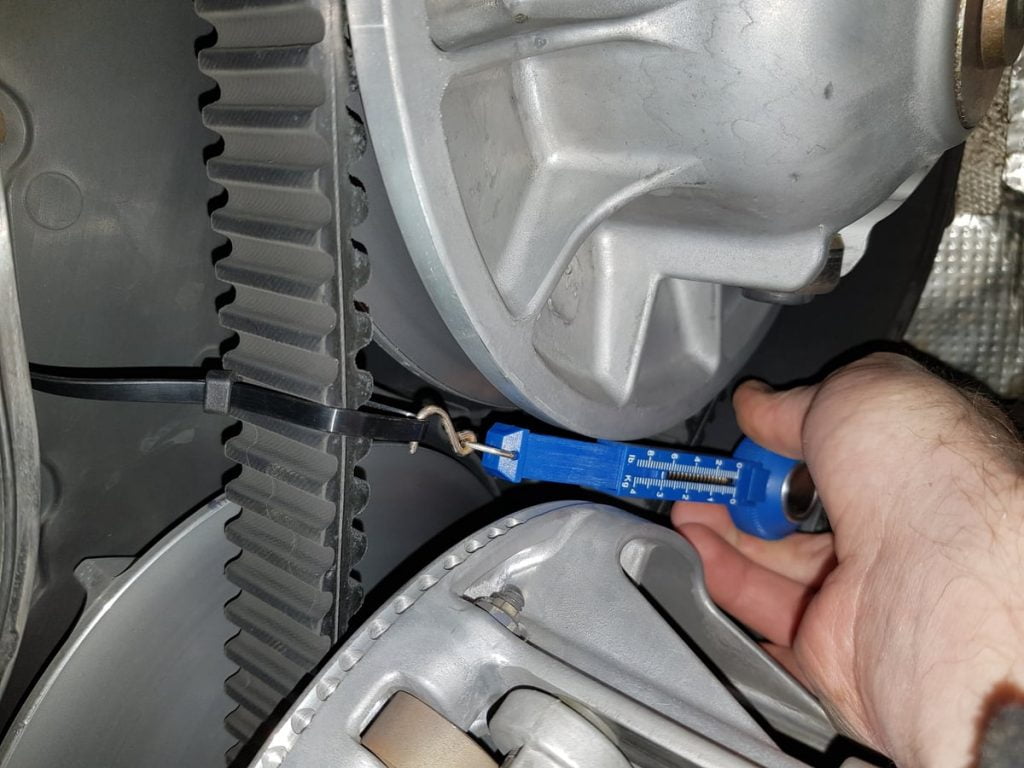
Adjust the chugalug deflection if necessary
Belt deflection is typically adjusted past turning an aligning spiral on the secondary clutch, or by adding or removing spacer shims in the secondary clutch.
Adjusting belt deflection on an ATV secondary clutch that has an adjustment spiral:
- Loosen the locking nut that holds the adjustment screw in place.
- Plow the adjustment spiral either clockwise or counterclockwise.
- Turning the spiral counterclockwise will bring the sheaves together, tightening the chugalug.
- Turning the screw clockwise will bring the sheaves further apart, loosening up the belt.
- Catch the belt and roll it through the primary and the secondary after adjusting. This will ensure that the belt falls in identify between each adjustment.
- Mensurate deflection and conform appropriately until the deflection is according to spec.
Adjusting belt deflection on an ATV secondary clutch that uses shims:
As with the primary, the shimming of a secondary clutch tin be done at dwelling house if you have the right tools. Once again, if you don't have the tools or skills, your best option is removing the complete clutch assembly and taking it to a dealer to practise the shimming for you. Alternatively, you can bring the whole ATV.
Symptom: The ATV bleat when moving
Some noise and vibration when driving are normal on any CVT clutch. Installing a snorkel may enhance these sounds. As so will pulling heavy loads at low speeds. Simply sometimes, the noise is higher than normal.
Possible cause one: The sheaves are dirty
Clutch sheaves may get dingy from a spinning ATV belt or from not cleaning a new belt with lather and hot water earlier installing information technology as you should.
How to fix it
- With the engine off, remove the clutch cover and drive belt.
- Employ a Scotch Brite pad and some hot soapy water to clean off any residue. Using sandpaper is not recommended as this may cause increased belt vesture and reduce its service life.
- Blow everything make clean with compressed air before reinstalling the belt and clutch comprehend.
Possible cause ii: Running higher rate clutch springs
Running bigger tires crusade excess stress on the bulldoze chugalug. If you go up more than than ane inch in size, you need stiffer clutch springs to accommodate the added stress.
Stiffer springs cause more belt noise due to the added tension. Information technology is normal to hear a noticeable difference betwixt your stock setup.

Source: https://boostatv.com/belt-squeal/
Posted by: dickersonressibing.blogspot.com
0 Response to "How To Clean Clutch On A John Deere Gator That Squeals"
Post a Comment